









Spring selection is one of the most misunderstood parts of reformer training. Participants may assume that more springs always mean a harder workout and fewer springs always mean an easier one. That rule works only in certain exercises. In others, a lighter setting makes the moving carriage less stable and increases the need for control.
In reformer pilates Singapore classes, spring choice should be treated as a programming decision rather than a status symbol. It changes carriage behaviour, the direction of assistance or resistance, the speed of return and the consequences of losing control. The correct setting depends on the exercise, equipment and individual.
Springs Do Not Equal Standardised Weights
Reformer springs are usually identified by colours, but colour systems are not universal. Two machines may use different colours or tensions. Even springs of the same stated type can feel different because of age, maintenance and equipment geometry.
This means a participant should not transfer a colour formula from one studio to another without checking. “Two red springs” is meaningful only within the relevant equipment system.
Springs also create tension rather than a fixed weight value. The force changes as the spring length changes. Carriage position therefore matters when describing the challenge.
Resistance Depends on Movement Direction
During footwork, the legs push the carriage away from the stopper, stretching the springs. Adding tension generally increases the outward force requirement and makes the return more powerful.
In a plank with hands on the footbar and feet on the carriage, stronger springs may help prevent the carriage from moving away. Reducing tension can make stabilisation harder because less spring force holds the carriage home.
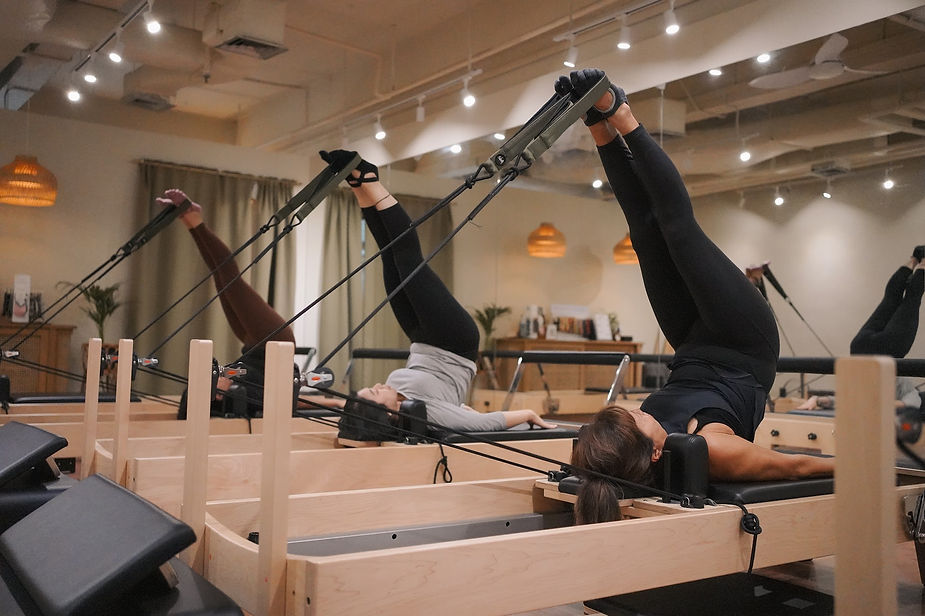
During pulling exercises, springs resist the straps as the carriage moves. On the return, those same springs assist the carriage towards its starting position. The practitioner must control that assistance.
Spring choice cannot be separated from which direction is considered the working phase. Both outward and return phases matter.
Heavier Springs Can Improve Stability
A heavier setting often keeps the carriage closer to the stopper. This can create a more secure learning environment for standing or weight-bearing movements, provided the practitioner can still move as required.
That stability may allow attention to shift towards foot placement, balance and joint alignment. It is not cheating. It is an intentional reduction of one difficulty.
However, strong spring return can be abrupt. If control is lost, the carriage may close quickly. A stable outward phase does not remove the need for careful deceleration.
Lighter Springs Can Increase Coordination Demand
With less tension, the carriage may move from a small shift in body weight. Muscles must respond quickly and precisely to keep it on the intended path.
This can be useful for advanced control tasks, but it may be inappropriate when a participant is unfamiliar, fatigued or unable to maintain secure contact. Instability should be introduced progressively.
A lighter setting may also reduce resistance too far in strap-based work. The straps can lose useful tension, making the line of pull inconsistent. The appropriate minimum is the setting that maintains a clear training stimulus and safe equipment behaviour.
Spring Selection Across Common Exercise Families
Footwork
Moderate or heavier settings usually provide a clear leg-strength challenge and predictable carriage path. The practitioner should still be able to control the final part of the return without letting the carriage strike the stopper.
Different foot positions do not automatically require the same springs. Calf-focused work, single-leg variations and restricted ranges may need adjustment.
Bridging
Springs influence how much the carriage moves as the hips lift. A heavier setting can reduce movement, while a lighter one can require more hamstring and trunk control. The instructor should decide whether the goal is hip force, spinal articulation or carriage stability.
Arm Straps
Too much resistance may cause the shoulders to elevate, elbows to bend unintentionally or ribs to lift. Too little may create slack and reduce feedback. The setting should allow a smooth line of pull through the chosen range.
Leg Straps
Spring tension interacts with leg weight and leverage. Straightening the knees increases the lever length and may make the same setting feel substantially harder. Range and leg position should be adjusted alongside springs.
Standing Work
The moving carriage creates balance demands. More spring support can be appropriate when learning. Reducing the springs should occur only if the practitioner can stop and reverse the carriage reliably.
Body Size Is Not a Complete Spring Guide
Body mass influences how a person interacts with the carriage, but it does not determine the ideal setting alone. Limb length, strength, experience, injury history and movement goal also matter.
A larger person may need stronger springs for support in one exercise and lighter resistance for comfortable range in another. A smaller person may be highly trained and capable of substantial resistance.
Instructors should observe movement rather than apply a fixed spring chart based only on appearance.
Use Spring Changes as Experiments
Instead of declaring one setting correct, compare two nearby options. Keep the exercise, range and tempo consistent, then observe what changes.
Does the carriage travel more smoothly? Can the return be controlled? Does the intended area work without compensation? Is breathing still available? The answers reveal more than the spring count alone.
Only one variable should change during the comparison. If foot position, tempo and range also change, it becomes difficult to understand the spring’s effect.
Spring Safety and Equipment Care
Springs should be attached securely before the practitioner changes position. The instructor should confirm that the carriage is stable and that fingers remain clear of attachment points.
Participants should not change springs during a loaded or unstable setup. Return the carriage home, establish a safe body position and follow the equipment procedure.
Studios need regular inspection and maintenance schedules. Visible corrosion, deformation, unusual sounds or damaged clips require attention. Users should report changes rather than assuming a spring is meant to feel different.
Programming Progression Beyond Spring Colour
Adding a spring is only one progression. Repetitions, tempo, pauses, range, base of support and unilateral work can all change the demand.
A participant may demonstrate progress by using the same springs with a slower return or more consistent carriage path. Another may reduce spring support in a balance exercise while maintaining control.
This broader view prevents training from becoming a race towards the heaviest combination. It also allows meaningful progress when adding resistance would distort the movement.
The Instructor’s Decision Process
Before choosing springs, the instructor identifies the objective. Is the session developing lower-body force, trunk control, shoulder organisation, mobility or balance? The same exercise can be programmed differently for each purpose.
The instructor then considers experience, symptoms and fatigue. At Yoga Edition, consistent teaching records can help practitioners repeat successful settings and understand why adjustments are made. This builds independence without encouraging unsupervised experimentation in unstable positions.
Verbal feedback should explain the effect: “This spring gives more support to keep the carriage home” is clearer than “This is the easy setting”.
When the Setting Is Wrong
A spring may be too heavy if range shortens dramatically, momentum replaces control or joint position changes to overcome resistance. It may be too light if the carriage drifts, straps lose tension or the practitioner cannot stop movement.
Sharp pain, numbness, dizziness and unstable contact are reasons to stop regardless of the setting. Medical concerns and rehabilitation needs require appropriate individual guidance.
Conclusion
Spring selection changes more than resistance. It alters stability, feedback, assistance and the speed with which the carriage returns. Its effect can reverse depending on the exercise.
Good reformer training matches springs to a clearly defined goal and observes the resulting movement. The best setting is not the most impressive combination. It is the one that creates an appropriate, controllable challenge.
Frequently Asked Questions
Are reformer spring colours standard across studios?
No. Colour and tension systems vary between equipment manufacturers. Follow the specific machine’s system and instructor guidance.
Why does my instructor add springs before standing work?
Additional tension may keep the carriage more stable and reduce unwanted movement while balance and setup are being learned.
Can I change springs while positioned on the carriage?
Only from a secure setup and according to instructor guidance. Never adjust springs while body weight makes the carriage or exercise unstable.
Do older springs provide less resistance?
Spring behaviour can change with wear and use. Studios should inspect and replace equipment according to manufacturer guidance rather than relying on appearance alone.
Should both legs always use the same spring setting?
Not necessarily. Single-leg variations may need different resistance because one limb carries more relative demand. Changes should be purposeful and supervised.
How can I tell whether a spring is too light?
The carriage may drift, straps may lose tension or the movement may become difficult to stop. Increase support or reduce the range as appropriate.


